
Williams College offers a BA in Psychology, with an honors track for students who complete a thesis in original empirical research. The college is accredited by the New England Commission of Higher Education (NECHE) and located in Williamstown, Massachusetts. Williams meets 100% of demonstrated financial need for all admitted students and accepts approximately 7% of applicants.


Founded in 1793, Williams College is a highly selective residential liberal arts institution in Williamstown, Massachusetts. The psychology department draws on 17 faculty members whose work spans behavioral neuroscience, cognitive, clinical, developmental, educational, and social psychology, with additional ties to several interdisciplinary programs across campus.
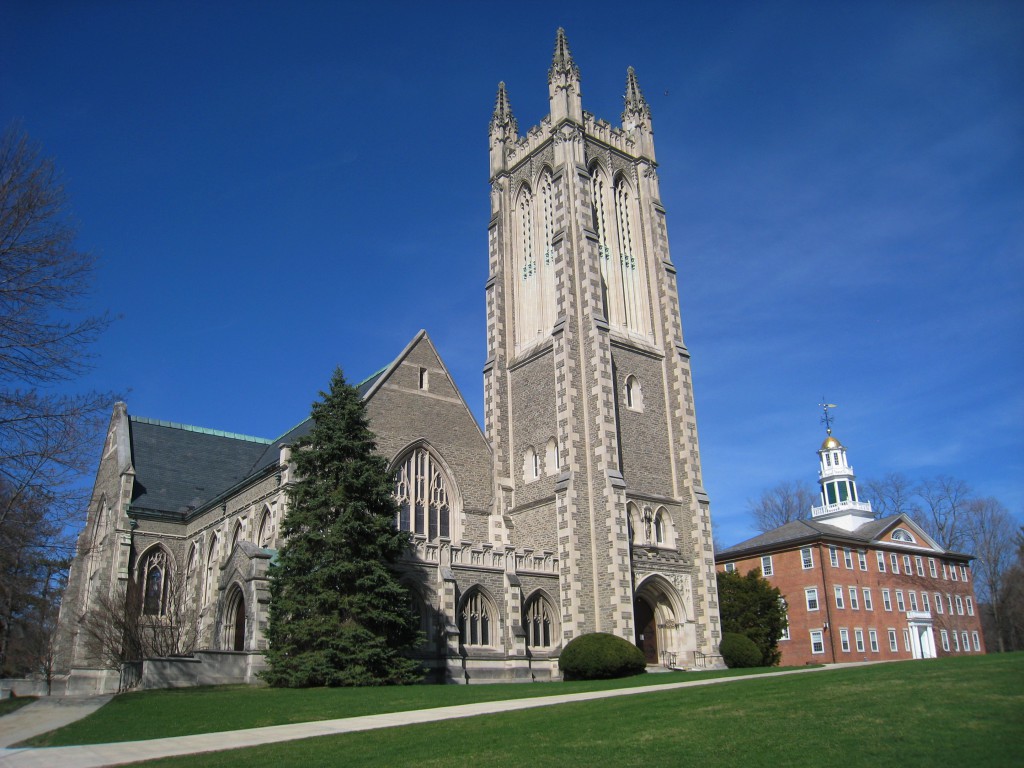
Accreditation Details
Williams College is accredited by the New England Commission of Higher Education (NECHE), the regional accrediting body for colleges and universities in Connecticut, Maine, Massachusetts, New Hampshire, Rhode Island, and Vermont. NECHE requires member institutions to undergo periodic comprehensive review to confirm continued compliance with accreditation standards. Williams also participates in academic consortia that expand research resources and collaborative opportunities for students and faculty.
Application Requirements
Williams accepts applications through the Common Application, the Coalition Application, and the QuestBridge Application. The college is test-optional. SAT and ACT scores are accepted but not required for admission. Required materials include a high school transcript, two teacher recommendations, a school counselor report, and a personal statement. Williams does not conduct admissions interviews and does not factor demonstrated interest into its decisions. An optional writing supplement is available for students who want to provide additional context.
The overall acceptance rate for the Class of 2030 was 7.4%, the lowest in the college’s history. Students applying through the binding Early Decision program see higher rates, approximately 25% for the Class of 2030. The Early Decision deadline is November 15. Regular Decision applications are due January 5.
Tuition and Financial Aid
Tuition at Williams for 2026–27 is $76,300. With housing ($9,830), meals ($9,490), and activity fees ($340), the comprehensive fee totals $95,960. Student health insurance through UnitedHealthcare is an additional $3,365 for students without comparable existing coverage.
Williams meets 100% of demonstrated financial need for all admitted domestic students and does not include loans in its financial aid packages. Approximately 56% of students receive some form of financial assistance. Among first-year students receiving need-based grants in 2024–25, the average scholarship or grant award was $76,769. The CSS Profile is the primary financial aid application document. Williams uses it to calculate demonstrated need. The FAFSA is not an initial requirement for the 2026–27 academic year, though enrolled students may be asked to submit it later. Aid packages are adjusted annually if a student’s financial circumstances change.
Psychology Programs at Williams College
BA in Psychology
The BA in Psychology requires 9 courses in total. Students begin with PSYC 101 (Introductory Psychology), a team-taught survey of the field, followed by PSYC 201 (Experimentation and Statistics), which covers research design, data collection, analysis, and scientific writing. At least three 200-level survey courses are required, drawn from areas including cognitive psychology, developmental psychology, social psychology, clinical psychology, neuroscience, and psychology of education. The curriculum also requires at least three 300-level lab or seminar courses, at least one of which must be a designated empirical lab course. For a closer look at the courses that make up a psychology major, see our full breakdown.
Psychology faculty are involved in several interdisciplinary programs at Williams, including Cognitive Science, Neuroscience, Leadership Studies, Justice and Law, and the Program in Teaching. Students can also pursue supervised applied experience through PSYC 21 (Psychology Internships). Many psychology majors choose to double major or concentrate in one of these related programs. For an overview of career options with a bachelor’s in psychology, see our dedicated guide.
Honors in Psychology
Students pursuing Honors in Psychology complete a two-semester thesis sequence (PSYC 493–494) based on original empirical work. Honors candidates take only two 300-level courses from two different areas in place of the standard three, but the thesis requirement adds a significant independent research component. Guidelines and eligibility criteria are available through the psychology department.
Browse accredited psychology programs by state to compare application requirements, tuition, and financial aid options at institutions across the country.