
Washington and Lee University offers psychology study through its Cognitive and Behavioral Science department, which awards a Bachelor of Arts and a Bachelor of Science in Cognitive and Behavioral Science. W&L holds primary accreditation from the Southern Association of Colleges and Schools Commission on Colleges and is a private liberal arts university in Lexington, Virginia.


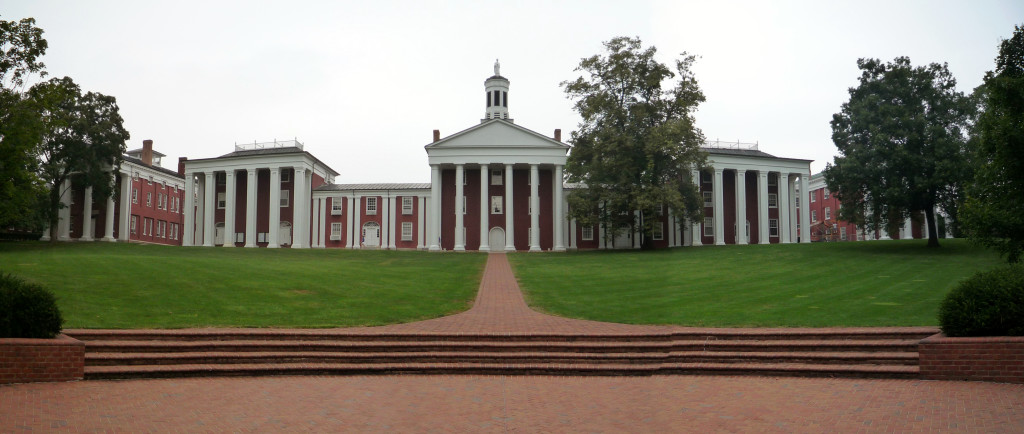
Washington and Lee University traces its roots to 1749, when it was founded as Augusta Academy in Virginia. The school adopted its current name in 1870 to honor Robert E. Lee, who served as its president after the Civil War and established the honor system that students still follow today. W&L is now a private liberal arts university in Lexington, Virginia, enrolling roughly 2,000 students, including about 300 in its law school.
Accreditation Details
Washington and Lee University holds primary institutional accreditation from the Southern Association of Colleges and Schools Commission on Colleges (SACSCOC), which authorizes the university to confer degrees upon students who complete its requirements. Several of W&L’s professional programs also carry specialty accreditation from organizations in their respective fields, including:
- Association to Advance Collegiate Schools of Business (AACSB)
- Accrediting Council on Education in Journalism and Mass Communications (ACEJMC)
- Association of American Law Schools (AALS)
- American Chemical Society (ACS)
- American Bar Association (ABA)
- Council for the Accreditation of Educator Preparation (CAEP)
- Virginia Department of Education
Application Requirements
Washington and Lee accepts applications through the Common Application, which allows students to submit a single application and set of essays to multiple schools at once. Applicants submit an official high school transcript, a school report, and a counselor recommendation, along with at least two teacher recommendation letters. A mid-year grade report and final transcript are required after acceptance. Whether standardized test scores are required or optional changes from year to year at many selective colleges, so confirm W&L’s current testing policy directly with the admissions office before applying.
Tuition and Financial Aid
Washington and Lee publishes its current tuition, fees, and total cost of attendance on the admissions website each year, since these figures change annually. W&L is need-blind and meets 100 percent of every admitted student’s demonstrated financial need through grants, scholarships, and guaranteed campus work, without requiring loans.
Students should file the FAFSA to determine eligibility for federal grants and loans. The university also offers merit scholarships, including the Johnson Scholarship Program, which covers full tuition, room, and board for a select group of incoming students each year.
Psychology Programs at Washington and Lee University
Psychology coursework at Washington and Lee is housed in the Cognitive and Behavioral Science department, which offers a major leading to either a Bachelor of Arts or a Bachelor of Science. Both tracks share a foundation in brain and behavior, cognition, developmental psychology, and social psychology before diverging into more specialized coursework. For a broader look at what separates a BA from a BS in psychology, including the general tradeoffs beyond this specific program, see our full comparison.
Cognitive and Behavioral Science, B.A.
The B.A. track requires 40 credits and gives students more room for coursework outside the department, while still including a foundations sequence, statistics, and research design, as well as an upper-level specialization in an area such as cognitive neuroscience, developmental psychopathology, or social psychology.
Cognitive and Behavioral Science, B.S.
The B.S. track requires 50 credits and places greater emphasis on STEM coursework and laboratory research than the B.A. track. Students complete the same foundations and statistics sequence, choose two specialization courses, finish a research capstone in an area like attention, language, and emotion, or developmental psychology, and round out the major with at least 22 additional credits in biology, chemistry, computer science, math, neuroscience, or physics.
Select your state below to find accredited psychology programs, application links, and licensing requirements for your jurisdiction.