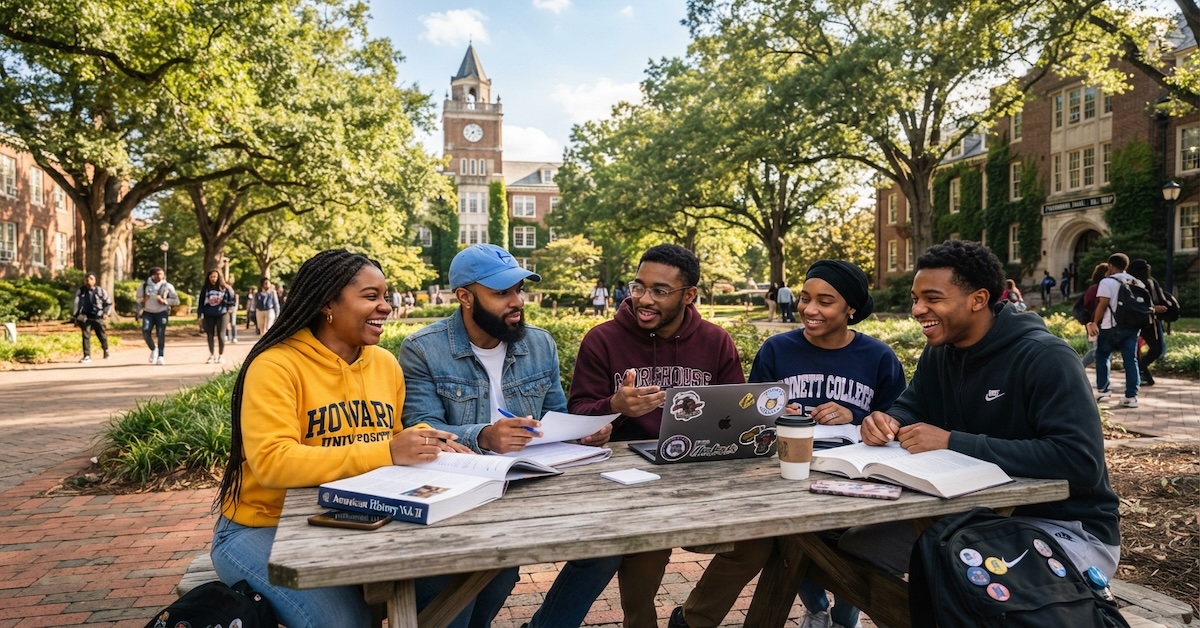
Dozens of HBCUs offer psychology degrees, from bachelor’s programs at Hampton and Morris Brown to Howard University’s APA-accredited PhD in Clinical Psychology, the first program of its kind at any HBCU. Scholarship funding has shifted recently, but active sources like the Thurgood Marshall College Fund and UNCF still support HBCU psychology students specifically.


You’ve probably pictured yourself walking through Howard’s yard or packed into a lecture hall at Spelman. Still, there’s a nagging question sitting right behind that image: Does an HBCU psychology program actually stack up, or are you settling for something smaller? Right behind that one is a money question, because a chunk of the HBCU scholarship list you might have bookmarked last year has quietly disappeared. Here’s what’s actually still standing, school by school and dollar by dollar.
Use the links below to jump to program details, accreditation rules, funding sources, or straight to a specific school.
- Why consider an HBCU for a psychology degree
- Compare all nine HBCU psychology programs
- Accreditation and licensure: what to verify before you apply
- HBCU-specific scholarships and funding
- How to choose the right program for your goals
- Frequently asked questions
- Key takeaways
Why Consider an HBCU for a Psychology Degree
Psychology departments at HBCUs don’t just teach the standard textbook theories and call it a day. A lot of them build the African American experience and multicultural mental health directly into the required curriculum instead of treating it as an elective afterthought. Spelman’s program, the single largest major on campus at around 450 students, frames its core theories explicitly around the African American experience and the experience of women. Morehouse builds its entire department around understanding Black men as a whole, capable, and self-directed, not through a deficit lens.
That framing isn’t just a nice-to-have. Psychology and counseling have a well-documented shortage of Black clinicians, and HBCU programs are among the more direct pipelines for addressing that gap, whether you end up in clinical practice, school psychology, or research. Before you compare specific schools, it helps to know how bachelor’s, master’s, and doctoral psychology degrees differ, since that’s what decides which of the nine programs below actually fits your goal.
HBCUs Offering Psychology Degrees at a Glance
The degree levels vary more than you’d expect. Some HBCUs stop at the bachelor’s. Others run all the way to an APA-accredited doctorate. Click any school below to jump straight to its section.
| School | Degree Levels | Accreditation Notes | Distinctive Focus |
|---|---|---|---|
| Delaware State University | BS, MS in Clinical Psychology (Counseling or Neuropsychology track), fully online | The counseling track follows CACREP’s core content areas without holding separate CACREP accreditation. | Fully online graduate psychology option |
| Florida A&M University | BA, BS, MS (Community Psychology) | MS is university-reviewed, not separately APA-accredited | Black psychology emphasis, thesis-heavy track toward a doctorate |
| Hampton University | BA, MS (Psychology), MA in Counseling (several concentrations), doctorate in Counselor Education | Doctorate is a counselor-education program, not an APA-accredited psychology PhD | The broadest range of degree levels on this list |
| Howard University | BS, PhD in Clinical Psychology | PhD is APA-accredited, reaccredited through 2035, and the first Clinical Psychology PhD program at any HBCU. | Research-heavy, trains scientist-practitioners for underserved communities |
| Morehouse College | BA, BS (pre-health track) | Standard institutional accreditation | Curriculum centered on Black men’s psychology, men’s college |
| Morris Brown College | BA only | TRACS-accredited (a nationally recognized accreditor, not a regional one), regained in 2022 after a 20-year lapse. | The comeback story on this list |
| Shaw University | BA only | Standard institutional accreditation | Smaller program, general psychology |
| Spelman College | BA, BS (Mental Health or Neuroscience concentration) | Standard institutional accreditation, no separate specialty accreditation at the undergraduate level | Largest major on campus, women’s college, with built-in field placements |
| Tennessee State University | BS, MS in Counseling (Clinical Mental Health or School Counseling concentrations), PhD in Psychology, Counseling Psychology concentration | PhD is APA-accredited. MS in School Counseling is CAEP-accredited. A separate non-thesis MS in Psychology, Counseling Psychology concentration, is reviewed by the state higher ed commission rather than APA or CACREP. | One of only two HBCUs with an APA-accredited doctoral psychology program |

 Delaware State University
Program home: Wesley College of Health & Behavioral Sciences, Department of Psychology
- BS in Psychology
- MS in Clinical Psychology, Counseling track (leads toward Delaware’s LPCMH license)
- MS in Clinical Psychology, Neuropsychology track (research-focused, thesis required)
Delaware State runs the only fully online graduate psychology program on this list. The Counseling track follows CACREP’s core content areas without holding separate CACREP accreditation, so confirm directly with your state board how that distinction affects your specific licensure path. The Neuropsychology track swaps the internship for a thesis instead.
The bachelor’s program builds a multicultural orientation into the standard psychology curriculum from day one, exploring how race, gender, culture, and language intersect with the discipline. If you want a research foundation while staying open to grad school elsewhere, or you need a graduate program you can complete without relocating, this is the clearest option on this list.
 Florida A&M University
Program home: College of Social Sciences, Arts and Humanities, Department of Psychology
- BA in Psychology
- BS in Psychology
- MS in Community Psychology
FAMU’s graduate program is built around Community Psychology rather than clinical practice. The 31-credit core covers psychopathology, community counseling, evaluation, and personality testing, and is backed by 6 to 12 hours of thesis preparation, making it a natural stepping stone if you’re eyeing a doctorate later.
The curriculum leans into Black psychology and multicultural mental health throughout, and the strong thesis component means you graduate with real research experience instead of coursework alone.
 Hampton University
Program home: School of Liberal Arts and Education
- BA in Psychology
- MS in Psychology
- MS in Marriage and Family Studies
- MA in Counseling (Community Mental Health, School Counseling, Student Affairs, Pastoral Counseling, or Addiction Counseling concentrations)
- PhD in Counselor Education and Supervision
Hampton has the broadest degree ladder on this list. Undergrads earn a BA in Psychology, with electives ranging from political psychology to the psychology of advertising. Graduate students can choose an MS in Psychology, an MS in Marriage and Family Studies, or an MA in Counseling, each available in five concentrations.
Hampton’s doctorate trains people to train future counselors rather than preparing you for clinical psychology licensure yourself. None of Hampton’s programs are APA-accredited psychology doctorates, so if a doctoral-level clinical or counseling psychology license is your end goal, treat Hampton as a strong master’s-level stop before applying elsewhere for the doctorate.
 Howard University
Program home: College of Arts and Sciences, Department of Psychology (undergraduate); Graduate School, Department of Psychology (doctoral)
- BS in Psychology
- PhD in Clinical Psychology (APA-accredited)
Howard’s PhD in Clinical Psychology is the name that comes up first in almost every conversation about HBCU psychology programs, and it earns that spot. It’s the first Clinical Psychology PhD program at any HBCU, and Howard reports the program has been APA-accredited since 1987. It was just reaccredited for the maximum 10-year term, through 2035.
The five-year, full-time program trains scientist-practitioners who work with underserved communities, with strong training partnerships at the VA Medical Center, the National Institutes of Health, and Children’s National in the DC area. Undergrads earn a BS in Psychology, but the PhD is the reason this school anchors most HBCU psychology lists.
 Morehouse College
Program home: Division of Science, Technology, Engineering, and Mathematics (STEM), Department of Psychology
- BA in Psychology
- BS in Psychology (pre-health track available for students planning medical or dental school)
Morehouse keeps psychology undergraduate-only. What sets the department apart is its explicit framing: Black men’s psychology taught as a whole, capable, and self-directed, in close collaboration with Morehouse School of Medicine, Spelman, and Clark Atlanta.
If you’re considering psychology at an HBCU and want that lens built into your coursework instead of offered as an elective, Morehouse is the most direct option on this list.
 Morris Brown College
Program home: Department of Psychology
- BA in Psychology
Morris Brown is the comeback story here. The school lost its accreditation in 2002 due to financial mismanagement. It remained unaccredited for nearly two decades before regaining it in 2022 through TRACS, a nationally recognized accreditor distinct from the regional accreditors most schools on this list hold. That accreditation was just reaffirmed through 2031.
Psychology at Morris Brown is bachelor’s-only right now, with no graduate program yet. That’s not a strike against it. It’s a rebuilt department at a rebuilt college, but it’s a different animal from a 90-year-old, fully doctoral program like Howard’s, and you should walk in knowing which one you’re choosing.
 Shaw University
Program home: School of Arts, Science, and Humanities, Department of Health, Human, and Life Sciences
- BA in Psychology
Shaw keeps things simple: a single BA in Psychology, built around 55 credit hours in the major covering clinical, cognitive, developmental, and social psychology. It’s a smaller department than most on this list, which can mean more direct faculty attention if that’s what you want out of an undergraduate program.
There’s no graduate psychology track at Shaw, so treat it strictly as a bachelor’s-level starting point before applying elsewhere for a master’s or doctorate.
 Spelman College
Program home: Division of Social Sciences and Education, Department of Psychology
- BA in Psychology
- BS in Psychology, Mental Health concentration
- BS in Psychology, Neuroscience concentration
Spelman’s psychology department is the largest major on campus, drawing around 450 students, roughly a fifth of the student body. The BA is the base requirement for everyone, with BS-level concentrations available in Mental Health or Neuroscience, plus field placements at community mental health sites that start as early as your undergraduate years.
Like Morehouse, the curriculum explicitly builds in the African American experience and the experience of women rather than treating that context as supplemental. There’s no graduate program at Spelman, but the research pipeline to graduate programs elsewhere is among the strongest on this list.
 Tennessee State University
Program home: College of Education, Department of Psychological Sciences and Counseling
- BS in Psychology
- MS in Counseling, Clinical Mental Health concentration
- MS in Professional School Counseling (CAEP-accredited)
- MS in Psychology, Counseling Psychology concentration (non-thesis, reviewed by the state higher ed commission)
- PhD in Psychology, Counseling Psychology concentration (APA-accredited)
Tennessee State runs the other APA-accredited doctoral program on this list. It doesn’t get nearly the attention Howard’s program does, but it’s a legitimate second doctoral path if Howard’s admissions numbers feel out of reach.
Below the doctorate, TSU actually runs three distinct master’s-level options, listed above. Know which one you’re applying to before you submit anything, since they lead to different outcomes: one leads toward clinical mental health counseling, one toward CAEP-accredited school counseling licensure, and one is a state-reviewed academic track rather than a licensure pipeline.
If you want to see how the doctoral options above stack up against choices beyond the HBCU list, our roundup of affordable clinical psychology doctoral programs is a good next stop. Whichever path you’re weighing, there’s one thing everyone needs to verify before applying.
Accreditation and Licensure: What to Verify Before You Apply
Here’s the mix-up that trips people up. A school being accredited and a specific program being accredited are two different facts, and you need both pieces before you enroll. The APA doesn’t accredit bachelor’s degrees at all, nor does it accredit schools. It accredits specific doctoral programs, evaluated directly by the APA Commission on Accreditation, full stop.
| Accreditor | What It Actually Accredits | Where It Applies on This List |
|---|---|---|
| APA (American Psychological Association) | Specific doctoral programs in clinical, counseling, or school psychology, not schools or bachelor’s degrees | Howard’s Clinical Psychology PhD, Tennessee State’s Counseling Psychology PhD |
| CAEP (Council for the Accreditation of Educator Preparation) | School counseling and other educator-preparation programs | Tennessee State’s MS in Professional School Counseling |
| CACREP (Council for Accreditation of Counseling and Related Educational Programs) | Counselor-education master’s programs | Referenced by Delaware State’s Counseling track, which follows CACREP’s core areas without holding separate CACREP accreditation |
| Regional accreditors (for example, SACSCOC, Middle States) | The institution as a whole, which is what makes federal financial aid possible | Every school on this list except Morris Brown |
| TRACS (Transnational Association of Christian Colleges and Schools) | The institution as a whole is a nationally recognized alternative to regional accreditors | Morris Brown College |
So “APA-accredited psychology bachelor’s” isn’t a real category anywhere, HBCU or not, and a master’s program that “follows CACREP’s core areas” isn’t the same as being CACREP-accredited. Licensure rules also vary by state, so whatever program you pick, confirm the specific requirements with the psychology or counseling board in the state where you actually plan to work. Our breakdown of how psychologist licensure works state by state is a good starting point before you rely on any single school’s marketing page.
HBCU-Specific Scholarships and Funding for Psychology Students
Now the money question. Some of the HBCU-specific scholarship lists floating around online are stale. Several private organizations ended their HBCU-targeted scholarship programs in 2025 following federal guidance challenging DEI initiatives at publicly funded institutions, so a chunk of what you’ll find in older blog posts no longer exists.
| Funding Source | Eligibility | Status as of This Writing |
|---|---|---|
| Thurgood Marshall College Fund | Students at TMCF member HBCUs | Active |
| UNCF General Scholarship | Full-time undergrad or grad students at UNCF member schools, 2.5 GPA minimum | Active |
| HBCU Endowment Fund | HBCU students generally | Active |
| Private and corporate HBCU-specific funds | Varied by funder | Several were discontinued in 2025; verify before relying on any single one |
| SAMHSA and NBCC minority mental health fellowships | Counseling or psychology grad students committed to underserved populations, not HBCU-exclusive | Active |
Beyond HBCU-specific money, mental health fields have their own funding pool that doesn’t care which school you attend, things like the SAMHSA-funded fellowships above for counseling and psychology grad students. Those aren’t HBCU-exclusive, but they’re worth stacking on top of anything school-specific.
Start with the FAFSA regardless. It unlocks federal grants and work-study before you even get to scholarship applications, and most of what’s listed above still requires it as a first step. If you don’t land an HBCU-specific award, our page on general psychology scholarship options is worth a look, too. Verify every scholarship through the official .edu or .gov channel before you apply. If it asks for a fee up front, it’s not real.
How to Choose the Right HBCU Psychology Program
Work backward from your actual goal. If you’re set on licensure as a psychologist, you need a doctoral pipeline, which currently means Howard or Tennessee State, or a bachelor’s degree anywhere on this list, followed by a doctoral program elsewhere. If you want a master’s-level counseling career, FAMU, Hampton, and Delaware State all get you there, with Delaware State the only fully online option. If you’re still deciding, a strong bachelor’s foundation with real research opportunities, like at Spelman or FAMU, keeps every later door open.
Campus culture matters too. Single-sex education at Spelman or Morehouse isn’t for everyone, and a smaller, rebuilding program like Morris Brown offers a different kind of community than a research-heavy department like Howard’s.
Frequently Asked Questions
Which HBCUs are known for having the strongest psychology programs?
Howard is best known for its APA-accredited Clinical Psychology PhD, the first program of its kind at an HBCU and one of the longest-established nationally. Spelman has the largest psychology department by enrollment and a strong research pipeline into graduate school. Tennessee State runs the other APA-accredited doctoral program, and FAMU and Hampton offer the broadest range of degree levels below the doctorate.
Are there APA-accredited psychology PhD programs at HBCUs?
Yes, two that we could verify. Howard University’s PhD in Clinical Psychology and Tennessee State University’s PhD in Psychology, concentration in Counseling Psychology, are both currently APA-accredited.
Can I study psychology online at an HBCU?
Delaware State University offers a fully online MS in Clinical Psychology with a Counseling track that leads to LPCMH licensure, or a Neuropsychology track. It’s currently the clearest fully online graduate option among HBCU psychology programs, though most undergraduate programs on this list are campus-based.
Will an HBCU psychology degree prepare me for licensure as a psychologist?
Yes, the same rules apply everywhere. You’ll need a doctoral degree, supervised practice hours, and a passing EPPP score, no matter which school issues your diploma. What actually matters for licensure is the specific program’s accreditation status, not whether the school is an HBCU.
Are HBCU-specific psychology scholarships still available?
Some are, though the list is shorter than it used to be. The Thurgood Marshall College Fund, UNCF, and the HBCU Endowment Fund are all still active as of this writing. Combine those with the FAFSA and any mental-health-field-specific fellowships you qualify for.
Key Takeaways
- As of this writing, two HBCUs have APA-accredited doctoral psychology programs—Howard University’s Clinical Psychology PhD and Tennessee State University’s Counseling Psychology PhD.
- APA accredits programs, not schools or bachelor’s degrees. Verify the specific program’s accreditation status, not just the institution’s.
- Morris Brown is a real comeback story, not a red flag. It regained accreditation in 2022 after a 20-year lhiatus but currently offers psychology only at the bachelor’s level
- The HBCU scholarship landscape shifted in 2025. Some private funds ended, but TMCF, UNCF, and the HBCU Endowment Fund are still active.
- Delaware State is the online option. Its MS in Clinical Psychology is the clearest fully online graduate path on this list.
Search for HBCUs and other accredited psychology programs near you, complete with application links and admissions details.